Damaged goods in road transport: who is liable under the CMR and how to protect yourself
Who pays for goods damaged in international road transport, when the carrier is not liable, and how to prevent damage or settle a claim quickly.
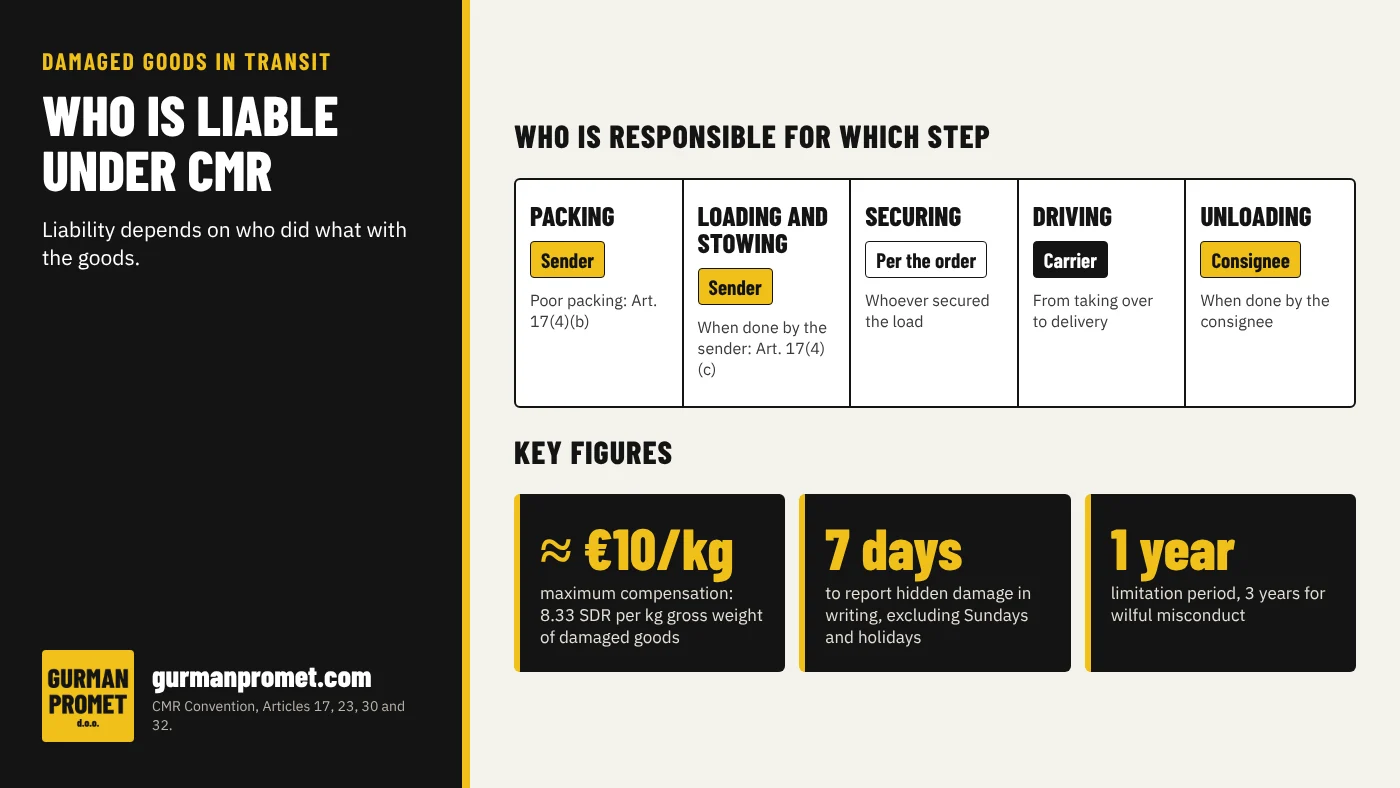
When goods arrive damaged, the first question is always the same: who pays? The answer isn’t automatically “the carrier”. The CMR Convention sets out exactly when the carrier is liable, when it isn’t, and how much it has to pay at most. Here we explain those rules in plain English, with a case from our own work and practical tips for preventing damage – whether you ship the goods or haul them.
In shortThe carrier is, in principle, liable for damage from the moment it takes over the goods until delivery. It is not liable if the damage was caused by poor packing, by loading or stowage carried out by the sender, by unloading at the consignee or by the nature of the goods themselves. And even where it is liable, its liability is capped at around €10 per kilogram of damaged goods.
Who is liable for damaged goods
Under Article 17 of the CMR Convention, the carrier is liable for total or partial loss of, and damage to, the goods occurring between the time it takes them over and the time of delivery, as well as for delay in delivery. It is liable for its drivers and subcontractors as if they were its own acts. It cannot rely on a defective vehicle: if the curtain leaks or the equipment fails, that’s the carrier’s risk.
That doesn’t mean whoever drove the truck is to blame for every damage. In practice, liability depends on who did what with the goods:
| Task | Usually done by | Damage resulting from it |
|---|---|---|
| Packing and wrapping | Sender | In principle the sender’s |
| Loading and stowage | Sender (or as set out in the transport order) | In principle the sender’s |
| Load securing | As agreed in the transport order | Whoever secured the load |
| Driving | Carrier | The carrier’s |
| Unloading | Consignee | In principle the consignee’s |
That’s why the transport order should state who loads, stows and secures the cargo. For more on what a transport order should cover, see our article on road freight documents.
When the carrier is not liable
Article 17(4) of the Convention lists special risks for which the carrier is not liable. The most relevant in day-to-day haulage are:
- missing or defective packing of goods that are liable to damage by their nature (point b),
- handling, loading, stowage or unloading by the sender, the consignee or anyone acting on their behalf (point c),
- the nature of the goods themselves, e.g. breakage, rust, decay or drying out (point d),
- insufficient or inadequate marks or numbers on the packages (point e).
The key rule is in Article 18(2): if the carrier shows that, in the circumstances, the damage could have been caused by one of these risks, it is presumed that it was. The claimant then has to prove otherwise. The carrier is also not liable if the damage was caused by the claimant’s fault, by the claimant’s instructions or by circumstances the carrier could not avoid.
Reservations on the CMR: at loading and at delivery
At loading
When taking over the goods, the driver has to check the number of packages, their marks and the apparent condition of the goods and their packaging (Article 8). If he enters no reservation, the goods are presumed to have been taken over in apparent good condition (Article 9). That presumption only covers what could be seen. A driver cannot check goods under stretch film, inside cartons or inside a wrapped pallet.
A good reservation is specific. For example:
- “Pallet no. 3: stretch film torn at the top edge.”
- “Number of packages could not be checked – loaded without the driver present.”
- “Loading and stowage carried out by the sender.”
A blanket “unchecked” without a reason carries little weight. A reservation that says exactly what is wrong, or why it couldn’t be checked, carries a lot.
At delivery
The consignee must note visible damage at delivery and report hidden damage in writing within 7 days, Sundays and public holidays excluded (Article 30). The reservation should at least give a general indication of the damage. If it doesn’t, the goods are presumed to have been received in the condition described in the CMR.
From our experienceWe recently received a claim for painted goods on which the consignee found minor scratches during its incoming inspection. They were underneath the stretch film and straps applied by the sender, and the sender had also loaded and stowed the goods. The pallets showed no external damage and no sign of the load shifting. Damage like this typically comes from products rubbing against each other inside the pallet when there is no protective layer between them. We did not accept liability, and our insurer took over the case straight away.
How much is paid
Where the carrier is liable, compensation is capped:
- at most 8.33 Special Drawing Rights (SDR) per kilogram of gross weight of the lost or damaged goods – roughly €10 per kilogram (Article 23),
- for damage, the carrier pays the loss in value, not the full price of the goods, and only for the part of the consignment that was actually damaged (Article 25),
- a higher amount is only possible if a higher value or a special interest in delivery was declared on the CMR against an agreed surcharge (Articles 24 and 26),
- the cap does not apply if the damage was caused by wilful misconduct or equivalent gross fault on the carrier’s side (Article 29).
ExampleThree items on one pallet are damaged, weighing 120 kg in total, and after repair the goods can only be sold at a 30% discount. If the carrier is liable, it pays that loss in value, capped at around €1,200 (120 kg × roughly €10). It doesn’t pay for the whole pallet, let alone the whole truck.
What to do when a claim comes in
- Don’t admit liabilityReply briefly and calmly: you have received the claim and will look into it. Don’t agree to pay or to a discount before the cause and the amount are clear.
- Notify your insurer straight awaySend the CMR, the transport order, the photos and the claim e-mail. Insurers deal with this every day and will often take over the correspondence with the customer.
- Ask for the documentsThe CMR with the consignee’s reservation, photos and a damage or survey report, the commercial invoice, the weight of the damaged part and a breakdown of the amount claimed.
- Collect your own evidenceA driver’s statement (who loaded, stowed and secured the cargo), photos from loading and unloading, the GPS log of the trip and the transport order with its terms.
- Don’t accept a deduction from your freightIf the customer wants to offset the amount against your freight invoice, object in writing immediately and inform your insurer.
Claims under the CMR are time-barred after one year, or three years in the case of wilful misconduct (Article 32).
How to prevent damage
The cheapest claim is the one that never happens. Most of the damage we see can be prevented with a few simple steps.
If you ship goods
- Separate painted and sensitive surfaces with cardboard, foam or film so products don’t rub against each other.
- Put edge protectors on the pallets before strapping.
- Mark on the pallet and in the transport order whether the goods are stackable.
- State in the transport order who loads, stows and secures the cargo.
- Take out cargo insurance for valuable goods – the CMR cap often doesn’t cover their full value.
If you haul goods
- Photograph the load at loading before closing the curtain, and at unloading before the forklift touches anything.
- Enter every visible irregularity on the CMR as a specific reservation.
- Check that the load is secured for the road: straps, anti-slip mats, gaps filled.
- Don’t leave the unloading point until the consignee has signed the CMR. If they enter a reservation, ask them to state exactly what is damaged.
From our experienceTime-stamped photos take a minute and are the strongest evidence you have if a claim comes in. That’s why our drivers photograph the load at every loading and unloading, together with the signed CMR.
FAQ
Is the carrier liable if the driver made no reservation at loading?
Not automatically. Without a reservation, the only presumption is that the goods and packaging looked fine from the outside. If the damage is under the packaging, or could have been caused by loading and stowage carried out by the sender, the carrier can still rely on Article 17(4).
Can the customer deduct the damage from the freight?
That depends on the contract and the applicable law, but without an agreement it is neither usual nor acceptable while liability and the amount are still open. If it happens, object in writing and involve your insurer.
Does CMR insurance cover every damage?
No. CMR insurance covers the carrier’s liability – only damage for which the carrier is actually liable under the Convention, and only up to the Convention’s limits. To cover the full value of the goods, the shipper needs cargo insurance.
Can I see your insurance certificate before the first job?
Yes. Our CMR insurance covers up to €2.5m, and you can request the certificate and a copy of our licence here. For a transport quote, send us an enquiry with the route and a description of the cargo.
Sources
- Convention on the Contract for the International Carriage of Goods by Road (CMR), Geneva, 1956 – Articles 8, 9, 17, 18, 23 to 26, 29, 30 and 32.
- IRU (International Road Transport Union): CMR – Frequently Asked Questions (PDF).
About the author
Josip Burazer, Managing Director, GURMAN PROMET d.o.o.
Josip Burazer is the managing director of GURMAN PROMET d.o.o. After several years working in logistics and road freight, he founded his own haulage company with trucks. Today he runs transport with new IVECO Euro 6 tractor units and curtainsider trailers, and his logistics experience – planning, loading, paperwork, border crossings and delivery slots – goes into every transport and into these articles. More about us