Road Freight between Croatia and Germany, the Netherlands and Belgium: FTL and LTL in Both Directions
Road freight between Croatia and Germany, the Netherlands and Belgium: full or part load, transit times, what drives rates and what to agree in the order.
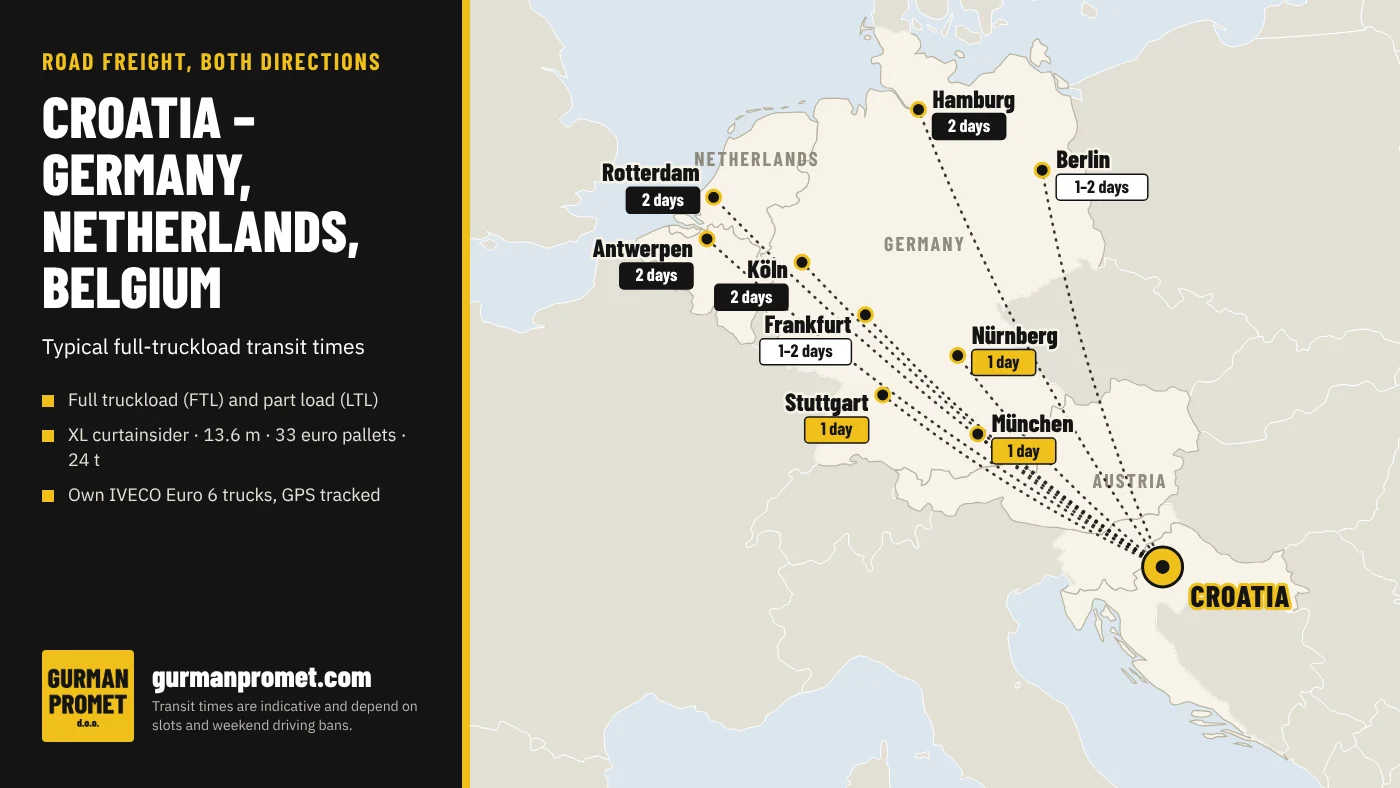
Germany is Croatia’s largest trading partner, and much of the Asian cargo bound for Croatia enters Europe through Rotterdam and Antwerp. That makes Croatia – Germany and Croatia – Benelux some of the busiest lanes for curtainsiders in south-east Europe. We run them regularly, in both directions. This guide explains how these transports work, how long they take, what drives the rate and what to agree up front so the truck is not left waiting.
In shortRoad freight between Croatia and Germany takes 1 to 2 days, and to the Netherlands or Belgium about 2 days. Larger volumes go as a full truckload (up to 33 euro pallets or 24 t); a few pallets go as a part load, where you pay only for the space you use. Within the EU there are no customs formalities: the cargo travels with a CMR consignment note, a delivery note and the transport order. The biggest time saver is a precise order with loading and delivery slots, a reference number and a warehouse contact.
Which lanes we run
We carry international road freight between Croatia and Germany, the Netherlands and Belgium in both directions, as well as cross-trade between those countries. The westbound route usually runs through Slovenia and Austria.
| Direction | Typical cargo | Transit time |
|---|---|---|
| Croatia → Germany | timber and furniture, steel structures, cables, industrial goods | 1–2 days |
| Germany → Croatia | machinery and equipment, spare parts, building materials, retail goods | 1–2 days |
| Croatia → Netherlands / Belgium | goods for distribution centres, industrial products | about 2 days |
| Netherlands / Belgium → Croatia | cargo from Rotterdam and Antwerp, palletised consumer goods | about 2 days |
From Croatia to Germany, the Netherlands and Belgium
For westbound loads from Croatia, what matters most is that the goods are ready on the agreed loading day and the consignee has confirmed a delivery slot. Croatian shippers mostly send wood and metal products, furniture, cables on drums and goods for onward distribution.
This direction often works in the shipper’s favour. More cargo flows into Croatia than out of it, so trucks look for westbound loads after unloading. Capacity out of Croatia is therefore usually easier to find, and rates are often lower than in the opposite direction.
Many deliveries in Germany and the Benelux go to distribution warehouses that only accept trucks in a pre-booked time slot. If the truck is late or no slot was booked, unloading is often pushed to the next day. Confirm the delivery slot before loading, not once the truck is already on its way.
From Germany to Croatia
Transport from Germany to Croatia is usually booked by the buyer in Croatia, who bought from a German supplier and arranges collection. A smooth pick-up then depends on how accurate the supplier’s information is.
Before booking, get the following from the supplier:
- the exact loading address (the warehouse is often not at the company’s registered address),
- warehouse opening hours and whether a slot must be booked,
- number of pallets, dimensions and gross weight, and whether pallets are stackable,
- the reference or order number under which the warehouse releases the goods,
- a contact name and phone number at the loading point,
- whether pallet exchange applies (common in Germany) or the pallets travel with the goods.
From our experienceWhen our truck waits at a German warehouse, it is rarely because of queues. Most often the driver does not have the reference or order number under which the goods are ready. Without it the warehouse will not release the cargo, and the calls to the customer and supplier easily take an hour or two. With the reference number in the order, loading usually goes through without delay.
From the Netherlands and Belgium to Croatia
For Croatia, the Netherlands and Belgium are above all the gateway for goods from other continents. Containers arrive in Rotterdam and Antwerp, are unloaded at distribution centres nearby and continue on pallets by truck. Consumer goods, electronics, equipment and retail stock are the most common loads from these hubs to Croatia.
The route runs through Germany and Austria and takes about two days. Large distribution centres apply the same rules as in Germany: a booked slot, a reference number and an exact pallet count. If you collect from a port warehouse, check that the goods have already been cleared into the EU and released. We only carry goods within the EU that are already in free circulation.
Transit times
Transit time depends mainly on distance and on how long one driver may drive: no more than 9 hours a day, extendable to 10 hours twice a week (Regulation (EC) No 561/2006). In practice that is 650 to 750 km a day, so anything longer is a two-day run.
| Route from Zagreb | Approx. distance | Transit time |
|---|---|---|
| Munich | about 560 km | same or next day |
| Stuttgart, Nuremberg | 650–800 km | next day |
| Frankfurt, Berlin | 1,000–1,100 km | 1–2 days |
| Cologne, Düsseldorf, Ruhr | 1,150–1,250 km | 2 days |
| Hamburg, Bremen | 1,250–1,400 km | 2 days |
| Antwerp, Brussels | 1,250–1,350 km | 2 days |
| Rotterdam, Amsterdam | 1,350–1,450 km | 2 days |
Weekend driving bans also affect transit times. In Austria, trucks may not run from 3 pm on Saturday to 10 pm on Sunday; in Germany, the ban applies on Sundays and public holidays from midnight to 10 pm. From 1 July to 31 August Germany adds a Saturday ban from 7 am to 8 pm on parts of the motorway network. Slovenia and other countries have their own bans, especially on public holidays.
From our experienceOn longer routes, cargo loaded on Friday afternoon realistically arrives on Monday, because the truck stands still over the weekend. If the goods must arrive before the weekend, plan loading for Thursday or Friday morning at the latest. What affects rate and transit time most is whether the delivery slot is fixed: a fixed slot means the truck has to leave earlier and build in a buffer.
Full truckload or part load
A full truckload (FTL) makes sense when the cargo fills most of the trailer, or when it is urgent and must travel direct. Our curtainsider trailers (13.6 × 2.48 × 2.70 m, about 91 m³) take 33 euro pallets or up to 24 tonnes. For bulky but light goods such as furniture, insulation or empty packaging, a full truck is usually the only sensible option.
A part load (LTL) suits a few pallets. You pay only for the space your cargo takes and share the truck with other consignments on the same route. Space is charged by loading metre (LDM); one loading metre is usually counted as 1,500 to 1,850 kg, so light cargo is charged by space rather than weight.
| Full truckload (FTL) | Part load (LTL) | |
|---|---|---|
| Volume | from about half a truck up to 33 pallets / 24 t | one to several pallets |
| Route | direct from loading to delivery | combined with other pick-ups and drops |
| Transit time | fastest and most predictable | depends on other consignments on the tour |
| Pricing | rate for the whole truck | by loading metre or weight |
More on our full truckload (FTL) and part load (LTL) pages.
What drives the rate
On these lanes the rate depends on distance, direction, volume and time windows, not on kilometres alone. The main factors are:
- the exact loading and delivery address, not just the city,
- road tolls in Germany, Austria and Slovenia, which make up a large share of the cost,
- direction: trucks heading west and heading into Croatia are not equally full,
- volume: full truck or part load,
- fixed loading and delivery slots and the number of drops,
- type of cargo and loading: side or top loading, additional load securing.
As a rough guide, a full truck on long routes currently costs around €1.70 to €1.80 per kilometre on the market, and a part load taking a third of the trailer often costs about half the full-truck rate. We quote every shipment individually, based on the actual addresses and slots.
Documents and what to agree in the order
Within the EU there are no customs formalities, so the paperwork is simple: the CMR consignment note, the delivery note and the transport order, plus an invoice or packing list if needed. We cover each of them in CMR, delivery note and transport order.
On lanes to Germany and the Benelux it pays to agree the following in the order:
- Loading and delivery slotsDate and time, and whether the slot has to be booked with the warehouse.
- Reference numberThe order or loading number under which the warehouse releases or receives the goods.
- Pallet exchangeWhether euro pallets are exchanged at loading and delivery or travel with the goods.
- Waiting timeHow many hours are included in the rate and what each additional hour or day costs.
- Loading and securingWho loads, stows and secures the cargo, and whether extra equipment is needed.
Clear responsibilities also matter if something goes wrong. We explain when the carrier is liable in Damaged goods in transit: who is liable under CMR.
Preparing the cargo
- Stack the goods on sound euro pallets, stretch-wrap them and protect the edges with corner boards.
- Separate painted or sensitive surfaces with cardboard or foam so products do not rub.
- Prepare heavy items such as machinery and cable drums so they can be strapped down.
- Label pallets with the order number and mark whether they may be stacked.
- Hand over the delivery note at loading and check the CMR details before signing.
Our drivers photograph the cargo at loading and delivery, together with the signed CMR. That protects both the shipper and us if the consignee later reports damage.
Frequently asked questions
How far in advance should I book?
For a full truck, 1 to 3 working days is usually enough, and next-day loading is possible when a truck is nearby. Part loads are fitted into tours we already run, so the earlier you ask, the better.
Are customs needed between Germany and Croatia?
No. Germany, the Netherlands, Belgium and Croatia are all EU member states, so goods in free circulation in the EU need no customs procedure. A CMR, delivery note and invoice are enough.
Do you also run Germany – Netherlands or Belgium, without Croatia?
Yes. We also carry cross-trade between other EU countries, most often as part of a westbound tour or on the way back towards Croatia.
Is the cargo insured?
The carrier is liable for the cargo under the CMR Convention, and our CMR liability insurance covers up to €2.5m. For high-value goods we recommend that the shipper also takes out cargo insurance, because CMR liability is limited per kilogram.
Can I track the truck?
Yes. All our trucks have GPS, and we send the position and ETA on request.
Need a truck?Send us the loading and delivery addresses, number of pallets, weight and preferred dates, and we will send you a quote. Request a quote or ask for our licence and insurance certificate.
Sources
- Regulation (EC) No 561/2006 on the harmonisation of certain social legislation relating to road transport (driving and rest times).
- Convention on the Contract for the International Carriage of Goods by Road (CMR), Geneva, 1956.
- German Road Traffic Regulations (StVO), section 30(3), and the summer holiday driving ban regulation (Ferienreiseverordnung).
- Austrian Road Traffic Act (StVO 1960), section 42 (weekend and public holiday driving ban).
Croatia – GermanyTransit times for 13 German cities, a week on the road, cabotage and return loads: road freight Croatia – Germany.
About the author
Josip Burazer, Managing Director, GURMAN PROMET d.o.o.
Josip Burazer is the managing director of GURMAN PROMET d.o.o. After several years working in logistics and road freight, he founded his own haulage company with trucks. Today he runs transport with new IVECO Euro 6 tractor units and curtainsider trailers, and his logistics experience – planning, loading, paperwork, border crossings and delivery slots – goes into every transport and into these articles. More about us