Road freight documents explained: CMR consignment note, delivery note and transport order
The three documents behind every international road shipment, who issues them and what to check, with a real example and a pre-loading checklist.
Most problems in international road freight don’t happen on the motorway. They happen on paper. An incomplete CMR, a delivery note that doesn’t match the load, or a transport order that says nothing about waiting time – and the truck sits at the dock while the invoice sits unpaid. In this article we explain which documents travel with the goods, who issues them and what to watch out for, and we walk through one shipment from order to payment.
In shortEvery international road shipment relies on three core documents: the transport order (the agreement between the customer and the carrier), the delivery note (what has been shipped) and the CMR consignment note (the contract of carriage that travels with the goods).
| Document | Issued by | Purpose | Where it ends up |
|---|---|---|---|
| Transport order | The customer (shipper or freight forwarder) | Terms of the job: route, slots, rate, waiting time | With the customer and the carrier |
| Delivery note | The shipper | List of goods and quantities shipped | Travels with the goods; the signed copy stays with the consignee |
| CMR consignment note | The shipper, signed by the carrier as well | Evidence of the contract of carriage and of the condition of the goods | One original each for the sender, consignee and carrier |
Transport order
A transport order is the written agreement for a specific job. It is sent by the customer – usually a freight forwarder or the shipper itself – and confirmed by the carrier. Anything that is in the order is easy to prove later. Anything that isn’t becomes your word against theirs.
A good transport order covers:
- loading and unloading addresses and slots, including warehouse opening hours and the loading reference,
- the cargo: type of goods, number and type of pallets, gross weight, dimensions and whether the goods are stackable,
- vehicle requirements, e.g. a curtainsider certified to EN 12642 XL, number of straps, loading height,
- rate and payment terms, when the payment term starts (from receipt of scanned or original documents) and what the rate includes (tolls, ferry, extra drops),
- waiting time: how many hours are free and what each extra hour or day costs,
- pallet exchange: whether pallets are exchanged at loading and unloading,
- contacts at the loading and unloading sites.
From our experienceThe most common reason a truck waits at the dock is a missing loading reference. Without it the warehouse doesn’t know which goods to release, and the driver waits while everything is checked by phone. That’s why we ask for the reference before the truck sets off for loading.
If something is agreed by phone, confirm it in a short e-mail. That way both sides have the same record.
If the goods are dangerous (ADR), additional documents and vehicle equipment are required. This has to be stated in the enquiry, not on the day of loading.
Delivery note
A delivery note is the list of goods the shipper has actually sent: items, quantities, number of packages or pallets and the order number. It is not a contract of carriage and it replaces neither the CMR nor the invoice. By signing it, the consignee confirms what was received.
The golden rule: the number of pallets and the weight must match on the transport order, the delivery note, the CMR and the truck. Discrepancies are sorted out at loading, while the goods are still in front of the driver – not at unloading, a thousand kilometres away.
CMR consignment note
The CMR consignment note is the document that evidences the contract for the international carriage of goods by road and the condition of the goods at loading. It is based on the Convention on the Contract for the International Carriage of Goods by Road (CMR), signed in Geneva in 1956. The Convention applies whenever goods are carried by road for reward and the place of loading and the place of delivery are in two different countries, at least one of which is a contracting state. All EU member states and most other European countries are parties to it.
A separate CMR is issued for each consignment, so on a groupage run one truck may carry several CMRs. The Convention does not apply to postal consignments, funeral consignments or furniture removals.
Copies
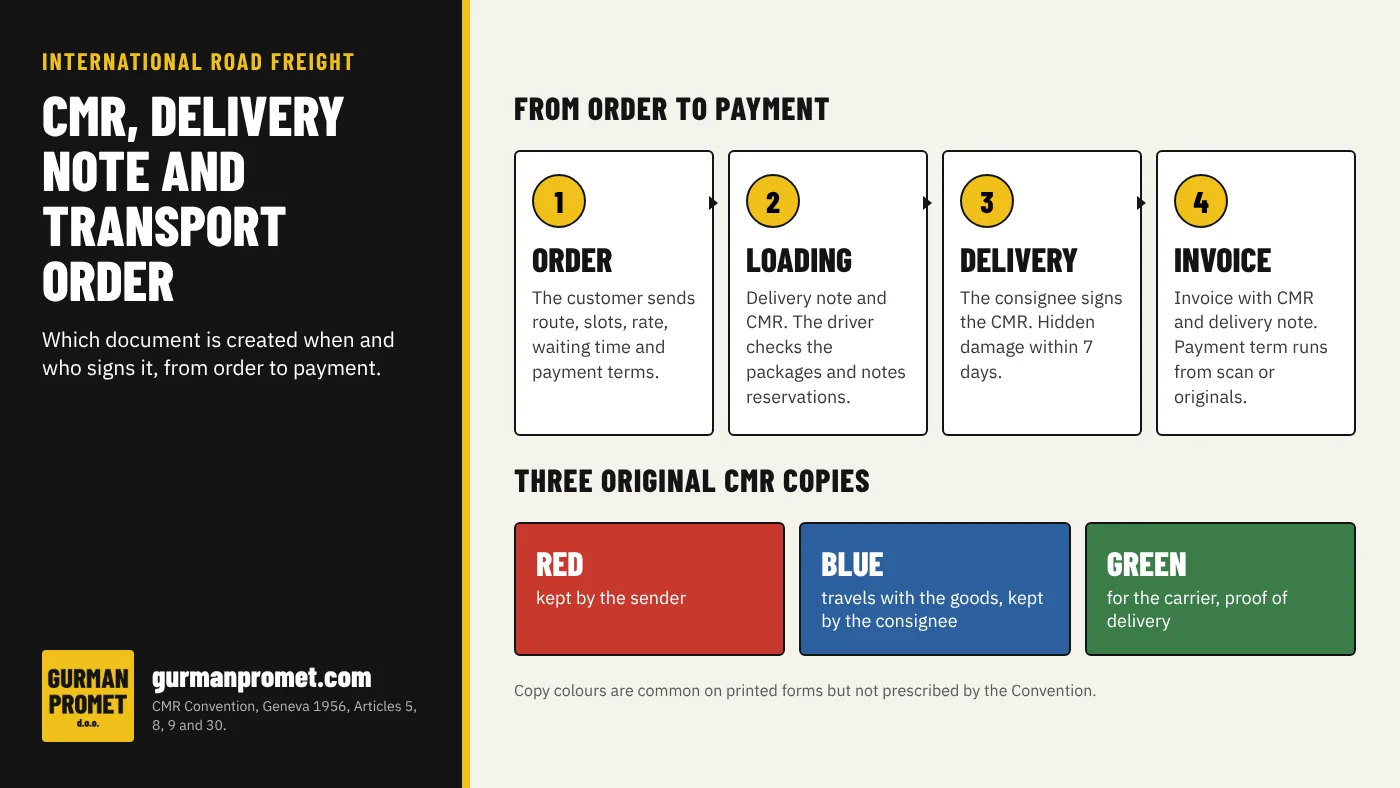
The CMR is made out in three originals, and most forms have a fourth copy. The first (usually red) stays with the sender, the second (blue) travels with the goods and stays with the consignee, and the third (green) is kept by the carrier as proof of delivery.
What the CMR must contain
- place and date of issue,
- names and addresses of the sender, the carrier and the consignee,
- place and date of taking over the goods and the place of delivery,
- the usual description of the goods and the method of packing,
- number of packages (pallets, cartons), their marks and numbers,
- gross weight or other quantity of the goods,
- charges relating to the carriage,
- a statement that the carriage is subject to the CMR Convention.
The sender is responsible for the accuracy of the details it provides. If the weight on the CMR is wrong or the description of the goods is incomplete, the consequences are the sender’s, not the carrier’s.
Signatures, stamps and reservations
At loading, the CMR is signed by the sender and the driver. At unloading, the consignee signs and stamps box 24 and adds the date and time of receipt. Without that signature the carrier has no proof that the goods were delivered.
From our experienceMost customers count a 60-day payment term from receipt of the original documents. After unloading, the truck is often on the road for another two weeks, so the originals only arrive once it is back – and the post needs another one to three days. In practice the payment term stretches by 15 days or more. It pays to agree in the transport order that the term runs from receipt of the scanned documents, with the originals following by post.
If the driver notices damaged packaging at loading or cannot check the number of packages, he enters a reservation on the CMR. Without a reservation, the goods are presumed to have been taken over in apparent good condition and in the stated quantity. The same applies to the consignee: visible damage is noted at unloading, and hidden damage must be reported in writing within 7 days (Sundays and public holidays excluded).
How much the carrier is liable for
Under the CMR Convention, the carrier’s liability for lost or damaged goods is limited to 8.33 Special Drawing Rights (SDR) per kilogram of gross weight – roughly €10 per kilogram, depending on the exchange rate. That covers most goods, but not high-value goods with a low weight.
ExampleA consignment of electronics weighs 800 kg and is worth €60,000. If it is lost, the carrier’s liability under the CMR is about €8,000. The remaining €52,000 or so is borne by the owner of the goods – unless a higher value was declared on the CMR against an agreed surcharge, or the goods were covered by separate cargo insurance.
So keep two things apart. CMR insurance is taken out by the carrier and covers its liability under the Convention. Cargo insurance is taken out by the shipper or the buyer and can cover the full value of the goods. For valuable goods it’s worth having both. Before the first job, always ask the carrier for its CMR insurance certificate. Our cover is up to €2.5m, and you can request the certificate and a copy of our licence here.
Electronic CMR (e-CMR)
More and more countries accept the electronic consignment note under the Additional Protocol to the CMR Convention. If your consignee or forwarder works with e-CMR, say so in the transport order so the driver has access to the right app in advance.
Example: one shipment from order to payment
A forwarder needs 24 euro pallets of ceramic tiles, 22 tonnes in total, moved from northern Italy to a warehouse in Austria. This is how the paperwork flows:
- Transport orderThe forwarder sends the order: loading on Tuesday between 8 am and noon with a loading reference, 24 pallets, 22 t, non-stackable, unloading on Wednesday, the rate, the payment term and two hours of free waiting time. We confirm the order and send the vehicle and driver details.
- LoadingThe shipper issues the delivery note and the CMR. The driver counts the pallets, checks the weight and secures the load. One pallet has torn stretch film, so he enters a reservation on the CMR. Shipper and driver sign the CMR.
- In transitThe vehicle is GPS-tracked, so the customer can get its position and ETA on request at any time.
- UnloadingThe consignee inspects the goods, signs the delivery note and box 24 of the CMR, stamps it and adds the date and time. Anything missing would be noted on the CMR there and then.
- InvoiceWe send the invoice with a scan of the signed CMR. The original CMR and delivery note follow by post once the truck is back. The payment term runs as agreed in the order: from receipt of the scan or of the originals.
Pre-loading checklist
- The transport order is confirmed in writing, including rate, payment terms and waiting time.
- The order states when the payment term starts: from scanned or from original documents.
- Number of pallets and weight match on the order, the delivery note and the CMR.
- Exact addresses, opening hours and contacts for loading and unloading are known.
- Pallet exchange has been agreed.
- Dangerous goods (ADR) have been declared in advance.
- Valuable goods have a declared value on the CMR or separate cargo insurance.
FAQ
Do I need a CMR for transport within the EU?
Yes. There are no customs inside the EU, but the CMR Convention applies to every carriage of goods between two countries. A shipment from Italy to Austria needs a CMR even though both countries are in the European Union.
Who fills in the CMR?
In practice usually the shipper or the forwarder, because they know the details of the goods. The driver checks what he can check – number of packages and the visible condition of the goods – and signs. The sender is responsible for the accuracy of the cargo details.
What if the consignee refuses to sign the CMR?
The driver should not simply leave. He informs the customer straight away, notes the reason and takes photos of the goods. Without a signature on the CMR there is no proof of delivery, which makes both payment and any later claim harder to deal with.
Can I book just part of a truck?
Yes. With groupage (LTL) you only pay for the space your goods take up, and your consignment gets its own CMR. Send us an enquiry with the route and a description of the cargo and we’ll come back to you with options.
Sources
- Convention on the Contract for the International Carriage of Goods by Road (CMR), Geneva, 1956, with the 1978 Protocol on Special Drawing Rights (SDR).
- IRU (International Road Transport Union): CMR – Frequently Asked Questions (PDF).
- UN: Additional Protocol to the CMR Convention concerning the electronic consignment note (e-CMR).
About the author
Josip Burazer, Managing Director, GURMAN PROMET d.o.o.
Josip Burazer is the managing director of GURMAN PROMET d.o.o. After several years working in logistics and road freight, he founded his own haulage company with trucks. Today he runs transport with new IVECO Euro 6 tractor units and curtainsider trailers, and his logistics experience – planning, loading, paperwork, border crossings and delivery slots – goes into every transport and into these articles. More about us