Full truckload (FTL): how the rate is calculated
A whole truck for your goods only, direct from loading to unloading, with no transshipment. Here is how a full truckload rate is worked out, what drives it and when FTL makes sense.
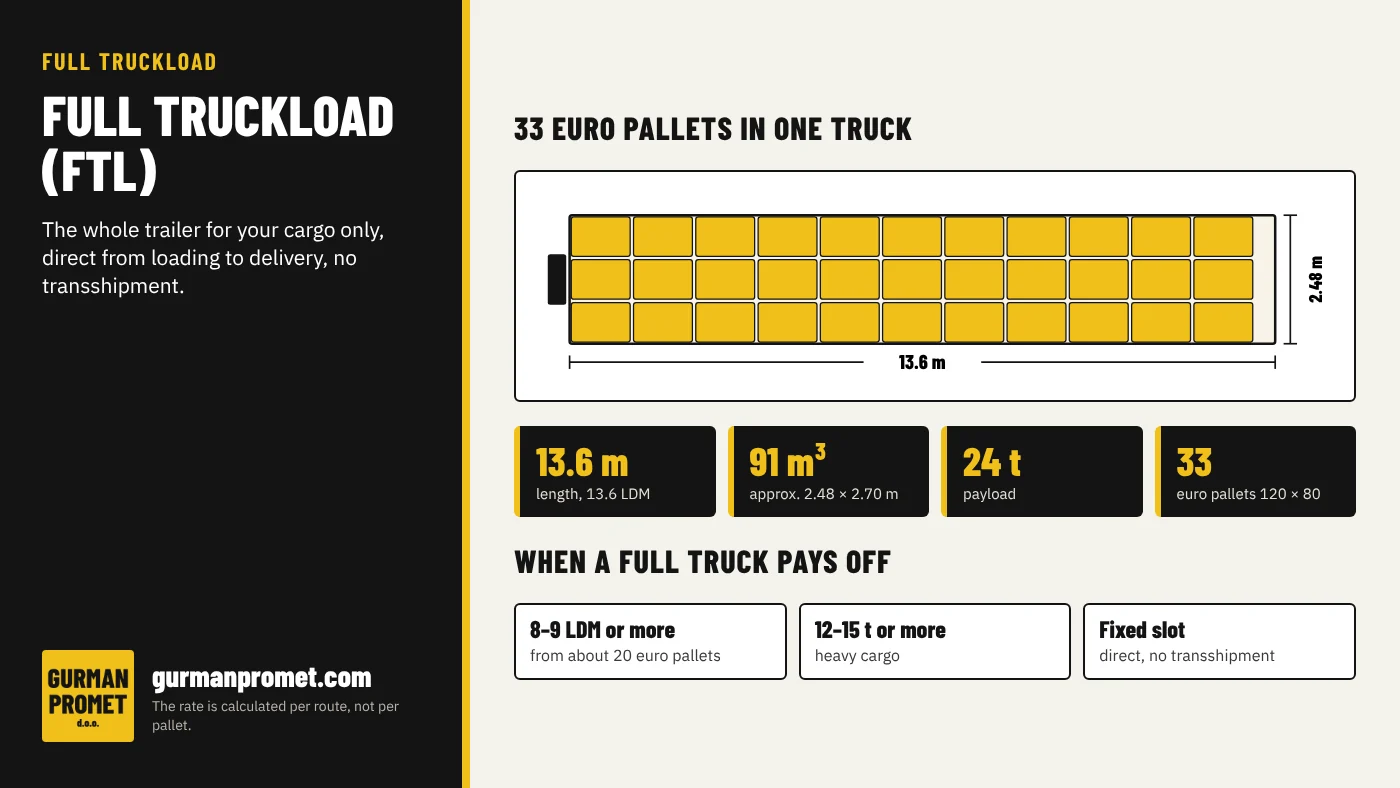
In shortA full truckload (FTL) means the whole trailer is yours: 13.6 m, up to 33 euro pallets and up to 24 t. The rate is set per route, not per pallet. On short routes each kilometre costs more, on long routes less. FTL usually pays off from about 8–9 loading metres (around 20 pallets), above 12–15 t, or whenever the goods have to arrive at a fixed time.
What fits in the truck
| Loading length | 13.6 m (13.6 loading metres) |
| Width and height | 2.48 m × 2.70 m, approx. 91 m³ |
| Payload | up to 24 t |
| Pallets | up to 33 euro pallets (120 × 80 cm) or 26 industrial pallets (120 × 100 cm) |
| Trailer | curtainsider certified to EN 12642 XL, side, top or rear loading |
How a full truckload rate is calculated
With a full truckload you pay for the route, not per pallet or per kilo. But no single rate per kilometre fits every job – and that’s the first thing an experienced dispatcher will explain.
- Short runs of up to a few hundred kilometres: the truck still spends a large part of the day getting there, loading, unloading and getting back. The rate is therefore closer to a day hire of the truck than a per-km price, so each kilometre is at its most expensive.
- Medium runs with same-day or next-day delivery: fixed costs are spread over more kilometres, so the rate per km comes down.
- Long runs where next-day delivery is no longer possible: here the rate is genuinely per kilometre. The market level for a full truckload on such lanes is typically around €1.70–1.80 per km, depending on direction, slot and tolls.
That’s a market range, not a price list or a quote. You get an exact rate for your route and slot.
When the truck is full before it’s heavy
A truck can be full in two ways: by weight (24 t) or by space (13.6 loading metres, about 91 m³). With bulky, low-density goods the space runs out long before the payload – sometimes at just 6–10 t. Typical examples:
- furniture, mattresses and upholstered goods,
- insulation, polystyrene and light building materials,
- empty packaging, PET bottles, cartons,
- machinery and equipment when relocating an office or plant.
Goods like these almost always travel as a full truckload, and you pay for space rather than kilos. If you ship bulky goods, give us the dimensions and say whether they can be stacked – that decides how much fits and how many trucks you need.
What drives the rate
- Fixed or flexible delivery slot. This has the biggest effect. If the goods must be at the dock at an exact time, the truck is planned around you alone. If the date is flexible by a day or two, we can combine the run with other loads and the rate goes down.
- Distance and direction. It also matters whether there are backloads from the destination. Lanes where trucks rarely find a return load cost more.
- Tolls. They vary from country to country, and the German truck toll is among the highest in Europe.
- Loading and unloading. Extra pick-ups or drops, restricted warehouse hours and expected waiting time.
- Weekends and public holidays. In Germany, trucks over 7.5 t may not run on Sundays and public holidays between midnight and 10 pm, so loading on Friday for delivery on Monday takes longer.
- Type of goods. Dangerous goods (ADR), high-value goods and cargo that needs special securing.
Transit times
Under EU rules a driver may drive up to 9 hours a day (10 hours twice a week), which is roughly 650–750 km a day. As a guide, from loading in Croatia:
- Slovenia, Austria, southern Germany, northern Italy: same or next day,
- central and northern Germany, Switzerland: 1–2 days,
- Netherlands, Belgium, France: 2 days.
With a full truckload there is no transshipment and no drops along the way, so it is the fastest way to move goods by road.
Full truckload or part load?
If you have less freight, you don’t need to pay for the whole truck. With a part load (LTL) you only pay for the space your goods take up. But a part load isn’t proportionally cheaper: half a truck doesn’t cost half the price, because a smaller shipment still means loading, unloading and planning. From about 8–9 loading metres a full truckload is often no more expensive – and it’s faster, with nobody handling your goods along the way. If in doubt, ask us to quote both.
What we need for an exact quote
- Postcode and town for loading and unloading.
- Loading date and whether the delivery slot is fixed or flexible.
- Type of goods, number and type of pallets, total weight.
- Whether the goods are stackable.
- Special requirements: top or side loading, warehouse opening hours, ADR.
Before your first shipment, it’s also worth reading which documents go with international road freight and who is liable if goods are damaged.
FAQ
How much does a full truckload cost per km?
On long runs where next-day delivery isn’t possible, the market level is typically around €1.70–1.80 per kilometre. On short runs each kilometre costs more, because the rate is closer to a day hire of the truck. The slot, the direction and tolls matter just as much.
Are tolls included?
Our quotes always state clearly what is included in the rate: tolls, any ferry and extra pick-ups or drops. No surprises on the invoice.
How far in advance should I book?
The earlier the better – it’s easier to fit the run in and the rate is usually lower. If we have a truck free nearby, next-day loading is possible too.
Do you only run from Croatia?
No. We run across the European Union, including routes that neither start nor end in Croatia.